Sitting in the dark movie theatre, watching the overly easy on the eyes actor, Michael Fassbender, I felt a bit like I had accidentally entered an art-house porn, if such a thing exists. The movie Shame, starts with Fassbender in bed, getting out of bed (nude), going to the bathroom, peeing (we see him from behind), hiring a call girl, paying her, getting back into bed and then noises of them having sex. The movie continues in this unrelenting pursuit of sex and watching sex with brief periods of wearing clothes, sitting on the subway (staring at women) and going into an office to do some unnamed high-tech work that doesn't involve a computer. A third of the way into the film we meet Sissy, naked in the shower. Played by Carey Mulligan, Sissy is his self-abusive, messed up little sister. She doesn't lighten the mood one bit and by the end you're just begging to get out of there. To get out of their destructive world. To not watch those two interact for one more second.
There were two things I liked about this movie: the first I've already mentioned. Fassbender is extremely attractive, with a body that could have inspired Michelangelo's David. The second thing is the moody and sultry New York, as directed by artist Steve McQueen. I can watch both of these subjects for hours. What I didn't like was the lack of story. We started in one place and, for the most part, ended up in that same place two hours later. Perhaps we didn't, maybe I'm staying too on the surface here, but since all the dialogue was trapped in Fassbender's head we'll never know.
Leaving the theatre, I overheard several conversations along these lines:
"Wow, I didn't expect it to be, like, all about sex."
"Yeah, I know. It's the only thing that happened."
"It was kind of uncomfortable watching all that sex."
"Um, so did anything happen in there?"
Next time I think I'll go see The Muppets.
Tuesday, December 6, 2011


Sunday, December 4, 2011
Things I Wish I Had Packed.
When I closed up my San Francisco apartment I had five years of stuff to collate. I had to decide what to bring with me for two years in New York and I had to decide what to put into storage. An unenviable task for sure. Now, four and a half months later, I think I have a good idea of where I want wrong. So, here goes, a list of things I wish I had brought with me:
1. All of my cooking spices (my apartment has none). I brought with me one single jar of seasoning, my favorite salt, I call it bacon salt. There's no real bacon inside but the smokey flavor makes you think it's there. I've since bought cayenne and salt but man, those little shakers are missed.
2. My red Le Creuset teapot (my apartment has none). I'm tired of heating up water, one mug at a time.
3. My blankets and sheets. Oh how I miss my high-thread count sheets from Frette. The selection at Bed, Bath & Beyond does not compare.
4. My plants. I know I couldn't have brought them, but I miss them. I wonder if they miss me?
5. A plastic kitchen thing that chops up a hard-boiled egg perfectly for egg salad. The fork and knife method is nowhere near as fun.
Five things I wish I had brought. Not too bad. Stay tuned for more.
1. All of my cooking spices (my apartment has none). I brought with me one single jar of seasoning, my favorite salt, I call it bacon salt. There's no real bacon inside but the smokey flavor makes you think it's there. I've since bought cayenne and salt but man, those little shakers are missed.
2. My red Le Creuset teapot (my apartment has none). I'm tired of heating up water, one mug at a time.
3. My blankets and sheets. Oh how I miss my high-thread count sheets from Frette. The selection at Bed, Bath & Beyond does not compare.
4. My plants. I know I couldn't have brought them, but I miss them. I wonder if they miss me?
5. A plastic kitchen thing that chops up a hard-boiled egg perfectly for egg salad. The fork and knife method is nowhere near as fun.
Five things I wish I had brought. Not too bad. Stay tuned for more.
Celebrating Poet Paul Violi.
I walked into the medium-sized room, with dozens of red chairs facing West 13th Street. Looking around, I wondered who I might see. Fellow students but more importantly poets. Real live I-get-paid-to-write poets. We were here for a tribute to Paul Violi, poet and professor at The New School. Until that night I was unfamiliar with his work. But after two hours of listening to his poems, read by big names in the poetry world, I was smitten. Smitten with his laugh out loud humor and dexterity with language. How many poets can get you to laugh out loud? He certainly had a way with the mundane, twisting and turning it, into something else.
Sitting in that room, listening to the voices of writers I had only read, I felt like I was invited into the inner circle of a writers club. It was a heady club: Poet Laureate Billy Collins, Charles North, novelist Paul Auster, Star Black, Ron Padgett, David Lehman, Robert Polito, George Green, David Shapiro, Robert Hershon and on and on and on. (Take time to go through those names, they all link to a bit of their work.)
What a night.
What a tribute.
Here's a link to the NY Times story.
I'll end with a poem:
Appeal to the Grammarians
by Paul Violi
We, the naturally hopeful,
Need a simple sign
For the myriad ways we're capsized.
We who love precise language
Need a finer way to convey
Disappointment and perplexity.
For speechlessness and all its inflections,
For up-ended expectations,
For every time we're ambushed
By trivial or stupefying irony,
For pure incredulity, we need
The inverted exclamation point.
For the dropped smile, the limp handshake,
For whoever has just unwrapped a dumb gift
Or taken the first sip of a flat beer,
Or felt love or pond ice
Give way underfoot, we deserve it.
We need it for the air pocket, the scratch shot,
The child whose ball doesn't bounce back,
The flat tire at journey's outset,
The odyssey that ends up in Weehawken.
But mainly because I need it—here and now
As I sit outside the Caffe Reggio
Staring at my espresso and cannoli
After this middle-aged couple
Came strolling by and he suddenly
Veered and sneezed all over my table
And she said to him, "See, that's why
I don't like to eat outside."
Sitting in that room, listening to the voices of writers I had only read, I felt like I was invited into the inner circle of a writers club. It was a heady club: Poet Laureate Billy Collins, Charles North, novelist Paul Auster, Star Black, Ron Padgett, David Lehman, Robert Polito, George Green, David Shapiro, Robert Hershon and on and on and on. (Take time to go through those names, they all link to a bit of their work.)
What a night.
What a tribute.
Here's a link to the NY Times story.
I'll end with a poem:
Appeal to the Grammarians
by Paul Violi
We, the naturally hopeful,
Need a simple sign
For the myriad ways we're capsized.
We who love precise language
Need a finer way to convey
Disappointment and perplexity.
For speechlessness and all its inflections,
For up-ended expectations,
For every time we're ambushed
By trivial or stupefying irony,
For pure incredulity, we need
The inverted exclamation point.
For the dropped smile, the limp handshake,
For whoever has just unwrapped a dumb gift
Or taken the first sip of a flat beer,
Or felt love or pond ice
Give way underfoot, we deserve it.
We need it for the air pocket, the scratch shot,
The child whose ball doesn't bounce back,
The flat tire at journey's outset,
The odyssey that ends up in Weehawken.
But mainly because I need it—here and now
As I sit outside the Caffe Reggio
Staring at my espresso and cannoli
After this middle-aged couple
Came strolling by and he suddenly
Veered and sneezed all over my table
And she said to him, "See, that's why
I don't like to eat outside."
Monday, November 21, 2011
The Critic as Artist.
Surrounded by black sweatered people, wild haired with thick framed glasses, a sea of New York critics, I made my way to the front of Tishman Auditorium. Hosted by the International Association of Art Critics, we were there to hear Peter Schjeldahl, the art critic for The New Yorker, lecture on the job of an art critic. I've been reading Schjeldahl since he began at The New Yorker, of course, I'm paying much more attention to his writing now that we share a hometown. Schjeldahl puts together sentences worth underlining. What I didn't expect, I mean, far, far from expect, was his dry, funny sense of humor. He made me want to spend time with him, smoking, even though I don't smoke, over a glass of whisky and talking about art and writing. He began his talk by saying he would keep it short, or as he said, "in the words of an old preacher, no soul saved after twenty minutes." Moving quickly through his promised short lecture, I jotted down as many things as I could. I don't think I can string them together into a clear piece, so I'll just include a few of the things he said that made me smile, or just hit home.
About reading a critics work:
"They operate in the flashing presence and when in the past read as outdated." I've actually been reading quite a bit of historical criticism, Pauline Kael, Leslie Fiedler, etc. and this definitely rings true.
On his job as a staff writer for The New Yorker:
"To hear me complain (about working for The New Yorker), you would have to have the ears of Superman and to concentrate. Until you die." Who doesn't want to work for The New Yorker, okay, maybe not everyone, but if there was a line to get a job at the magazine, and there was one of those deli ticket machines, I would be in the front grabbing every single number I could stuff in my hands.
On the craft of writing:
It takes me three days to get a sentence I like. The first paragraph is rewritten thirty times and the last paragraph is written once.
On what to do with your life, how to pick a career:
"Jasper Johns once said, find out what people like about you and exaggerate it."
On his education:
"Everything learned about art I learned on deadline."
Sitting in the audience I looked up towards Schjeldahl and thought, damn you have it good. And, I also thought, damn, you deserve it.
About reading a critics work:
"They operate in the flashing presence and when in the past read as outdated." I've actually been reading quite a bit of historical criticism, Pauline Kael, Leslie Fiedler, etc. and this definitely rings true.
On his job as a staff writer for The New Yorker:
"To hear me complain (about working for The New Yorker), you would have to have the ears of Superman and to concentrate. Until you die." Who doesn't want to work for The New Yorker, okay, maybe not everyone, but if there was a line to get a job at the magazine, and there was one of those deli ticket machines, I would be in the front grabbing every single number I could stuff in my hands.
On the craft of writing:
It takes me three days to get a sentence I like. The first paragraph is rewritten thirty times and the last paragraph is written once.
On what to do with your life, how to pick a career:
"Jasper Johns once said, find out what people like about you and exaggerate it."
On his education:
"Everything learned about art I learned on deadline."
Sitting in the audience I looked up towards Schjeldahl and thought, damn you have it good. And, I also thought, damn, you deserve it.
Friday, November 18, 2011
The Parsley Principle.
I spent Wednesday evening with Nigella Lawson and Adam Gopnick. It wasn't just the three of us. It was the three of us, and another couple hundred at the 92Y. There to talk about woman and food (um, hello?) I got the pleasure of hearing the two in conversation. More Nigella than Adam it was a fun, if not fully fulfilling conversation. One of the highlights was something called the Parsley Principle. Adam Gopnick mentioned this in talking about one of Nigella's latest books, a book where she had to state *exactly how much parsley was required for a recipe. As an aside, this specificity was only required for the American version. God we are nitpicky. Anyways, Adam then brought up how we're always forced to buy FAR more parsley then we can ever use and that this was how big business is made, making us buy more than we need. I thought I would take five minutes to see if I could come up with more things just like this. Here goes:
1. Shampoo (Why must these always be gigantic?)
2. Cable TV (You can't *just get HBO.)
3. Gym Memberships (You can't just go for one month.)
4. Spices
5. Nail Polish Remover
Well, that's as far as I got, I'm sure there are more. I'll come back to this list later.
Sunday, November 13, 2011
A New Station.
I recently moved. Along with the pains and sufferings of moving away from my favorite coffee place, it also meant a change to my subway station. No big deal I thought. I've got these trains down. Little did I know. Little do I know. My new station, Delancey, home of the F, M, J and Z, is convoluted, crowded and cruddy. I don't like it. I have yet to clearly know which track is which. Which direction, which train is running, where the heck is Jamaica? There's one level for the J, M and Z and one track below that is the F. I take the F most of the time so it shouldn't really be a problem. But it is. I still find myself down there waiting for a train–in the wrong direction. My body falls into patterns and my brain forgets to overrule these patterns. I stand there, my body thinks it's going to school so I'm waiting for an Uptown train. I don't figure out I'm headed in the wrong direction until I hear the driver announce the next stop. That's when my brain kicks in and hurls me off the train and I scurry up and over to the Brooklyn side. Unless of course I need to go Uptown, in which case, everything is ok.
Getting on the right car (in the right train) is a whole nother bowl of difficult. In New York trains are so long that if you're not careful you'll get off at 17th Street when you really just need to be at 14th Street. I want to be in the right car but it means I need to know which way is the front. As a subway newbie, perhaps getting in the right car is an added layer of complexity that I don't need.
In addition to wanting to be in the right car for my destination, I also like to exit the station so I'm closest to my house. This I have yet to accomplish. Why? Because when I go underground from the spot I'd like to come back up at, I'm taken down to the J, M, Z track. Once in I have to walk from one platform then down another level to take the F. So how do I get back up in that same way? I look at the signs, try to fix it in my brain but I haven't figured it out yet. I know my problems are in large part due to the cryptic signage that the MTA has posted around the station. Their inconsistent use of Downtown Brooklyn and Uptown leads me to be just as inconsistent with how I exit the station. It's my own little version of No Exit.
I have faith I'll figure it out, maybe in another three months?
Getting on the right car (in the right train) is a whole nother bowl of difficult. In New York trains are so long that if you're not careful you'll get off at 17th Street when you really just need to be at 14th Street. I want to be in the right car but it means I need to know which way is the front. As a subway newbie, perhaps getting in the right car is an added layer of complexity that I don't need.
In addition to wanting to be in the right car for my destination, I also like to exit the station so I'm closest to my house. This I have yet to accomplish. Why? Because when I go underground from the spot I'd like to come back up at, I'm taken down to the J, M, Z track. Once in I have to walk from one platform then down another level to take the F. So how do I get back up in that same way? I look at the signs, try to fix it in my brain but I haven't figured it out yet. I know my problems are in large part due to the cryptic signage that the MTA has posted around the station. Their inconsistent use of Downtown Brooklyn and Uptown leads me to be just as inconsistent with how I exit the station. It's my own little version of No Exit.
I have faith I'll figure it out, maybe in another three months?
Wednesday, November 9, 2011
Jean Georges (with a side of Katie Couric).

Let me set the stage. Trump tower, gleaming gold high rise at 1 Central Park West. I'm in the bathroom washing up before I go to lunch with my friend Tory. The bathroom is far from what you might expect, either in this towering tower, in something owned by "the Trump" or, last but not least, the only Ladies room for a restaurant with three Michelin stars. Ok. So I'm in the bathroom. And so is Tory, along with one other woman who has just scooted into the one and only stall. We're moving around slowly and carefully like goldfish in the tiniest of glass bowls. The door opens and in comes a small, well-dressed woman. She asks us if we're in line, a totally logical question on entry to a bathroom. Eyes downcast, like all good New Yorkers who have seen everything, Tory says something along the lines of no and she exits the room. At that point I take a close look at the woman who's just joined me in this tiny closet. It's Katie Couric. She smiles at me, her eyes simultaneously crinkling and twinkling. Her chestnut hair has that just blown flip. We trade positions and I grab my coat and jacket and as Katie (excuse me, you don't mind the first name do you?), Katie tries the door handle to the stall. I'm standing like two inches from her and say the only possible response, "There's someone in there." "Oh," Katie says, looking right at me, dazzling me with her "I'm on TV everyday" star persona, "Thank you for letting me know." We smile and I turn and leave.
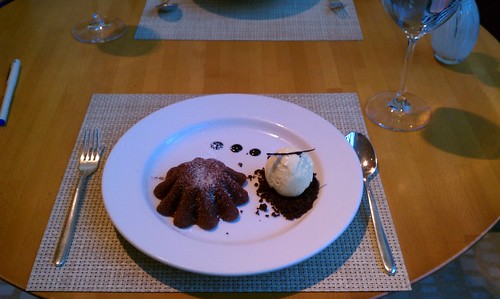
Now, how can a lunch following on the heels of Katie, a meal at Jean Georges' restaurant Nougatine, how could it possibly be bad? Granted we had a slightly rocky start with our service (as in, we had none for the first ten minutes) but after that, it was phenomenal. I had Tuna Tartare (shown above), a pan roasted skate on cauliflower and the warm chocolate cake (shown below). It's a $32 prix fix that will blow you away. Sure it's been around for years, sure we were surrounded by a businessy Upper West Sidey clientele, but the food was delicious and I savored every bite. Wrapping up the meal, sorry to see my third course come to its finale, I glanced out the windows. On that unseasonably warm day I could see Central Park, the trees changing colors, leaves gliding down to the sidewalk. I could feel New York welcoming me with all its might. Katie, I'll be back. Will you?
Subscribe to:
Posts (Atom)